Hello and welcome. I’m Sarah. You’ve found my online graveyard. This is where I bury my writing and whatever else can be feasibly put on a webpage. I hope you find something worth your while. (Best viewed on your desktop.)
Microsynthera is the taxonomic kingdom containing small man-made objects like rubberbands and breadclips. These things are essential but insignificant. They deserve our respect.
This site is (and will continue to be) under construction and is not provided to prevent or treat any disease. Also, everything you find here is a living document. Have a good .
Recieve a blessing at the Sine of Beneficence.
Asterisms
Our stars are innate but not our constellations. We can draw whatever lines we want up there. We pin them up one by one deciding our futures and describing our pasts, and don’t we tell such stories? Stories of warriors and beasts, hunting dogs and sinister queens. We log our births and deaths along the ecliptic with rams and twins and mermaids and maidens. And we ask each other: What stars are in your sky? What stories do they tell? And we should ask: Can we tell them together?
Eucalyptus
I am dripping eucalyptus
that scent like moths and half-moonlight.
It feels like the knit beneath your sheets, and
sticks clippings to the dada dancing on my skin.
It’s the taste of lemon balm lingering,
languid and laughing,
through the sun-soaked hours of late morning.
I think it’s even in that dark threshold
between our eyes. There, I uttered your name
as the boundaries blurred.
That scent like honey bees and the first quarter
covers me with strawberry kisses and yawns lupine
in my lap. She hunts skillfully, and I am, I fear,
possessed—the perfect game.
Elvish Digits
This converts hindu-arabic numerals into elvish ones. By “elvish numerals” I mean Tengwar duodecimal in order from least magnitude to most. I just think they are neat. Enjoy!
Tengwar made possible with the FairfaxHD font.
See the “numbers” section here for more details.
Phantasmagoria 1 Return To Sender
A woman in powder-blue coveralls regarded a field of stars. Julia called the Anadyomene-01 her temporary home, as she hoped she’d leave it soon. The sky she saw was set in a small circle of fused silicate glass. She directed her gaze at Earth; gently cradled in the centroid of the Summer Triangle. If only for a moment, she orbited that pale-blue mote. She took in its lustrous blues and vibrant greens—that flashing, twirling, singing radiological symphony—and quietly sighed. It’s no use crying now, she told herself, save it. She kicked off her bunk to set herself listing toward her station.
As she flew past, she grabbed a chair with velcro straps before a computer showing a calendar. She stopped—held by the fixed object—and swung herself into its seat. She pulled a pair of glasses up to her eyes from their cord around her neck. She peered at the screen. The year was 2109; the month was July. She tapped the seventh day. The screen filled with colorful chevrons. Next to each there was a task.
Audit CoR system logs / Trial 7 of dextrotetraacenaphthylene / Re-calibrate NIR imaging equipment / Transmit status…
She chorded the keyboard a couple times and black filled the screen.
A blinking cursor awaited her command.
Julia tapped in cor-audit -l.
The screen produced a long table of dated log entries.
Each date was paired with a short message.
Julia paged through these briefly before entering cor-audit -l -d0.
This time, only one entry appeared.
It was dated for July 7th, 2109, at 00:00.
Its description read, burn_, and nothing else.
What is this? A prank? Julia thought. Maybe that solar storm, but we were eclipsed… She investigated a few more commands, and said to herself, It’s not a prank. This is from CoR itself. She knew Symbol wouldn’t care. Just keep working, they would say. Julia undid the straps and kicked off the adjacent fuselage.
Across the room there were three inset cylindical racks. On two of them were bulky, air-tight suits, white and utilitarian, with the Symbol logo on the right breast: a square with the letter sigma in the center. Symbol values coordination, she recalled the orientation, because we are more than the sum of our parts. Sigma means summation, and the presenter put thick emphasis on the word sum. Julia remembered cringing at this.
The third rack was empty. To the left of the racks, beside the airlock, there was a gray box unseemingly bolted to the wall with a dial and a speaker. She floated up to it. She turned the knob, and the speaker began to whine. A voice protested over the noise. Julia dialed the knob back slightly and the whine ceased.
Julia began, “Are you alright, Thom? Over.”
The voice responded, “Yeah. What’d’ya need? Over.”
This is how Thomas normally started a conversation: “What’d’ya need?” He wasn’t supposed to be conducting a spacewalk unsupervised technically. But, there’s the safety protocol, then there’s the demands of the job, Thomas would say.
Julia proceeded, “There’s a weird log entry. I thought you might want to see it before I got rid of it. Over.”
Thomas called back, “Yeah, I saw that. I figure it’s the IT guys testing some new system. Probably nothing. We can just file it a 02-25. Over.”
That’s the code for a mistaken entry, Julia recalled. But that implies an actor posting a log manually in error. This was an automatic log from the CoR sensor network, it couldn’t have been a test or manual entry. “I was thinking the same thing.” She says, “Are you aligning the NIR camera out there? Over.”
The sensors on the Anadyomene-01 were in various stages of disrepair. Julia had to conduct repairs on the NIR camera nearly daily.
“10-4,” a pause. “Well, I was but—Christ, this station is falling apart—the cable needs to be replaced first. There’s no continuity on one of the data pins. Over,” Thom grumbled.
“I’ll send out a new cable.” She told him, then, “Thanks for looking at it this time. Over and out.”
She turned the dial back. For a moment she thought about Persephone, her green idol cactus back home. She had many cacti, but Persephone was special; Persephone was first. As she woke in the morning back home, drinking a warm glass of water, she would often sit and trace the cactus’s folds with her eyes. The warm water was a substitute for tea; the tea, a substitute for coffee; and, the coffee, a substitute for amphetamine.
The spare cables were kept fast to the wall above the hatch that held other spare parts including the carbon-dioxide removing air filters. These had to be replaced every three days before it became uncomfortable to breathe. When her mother called her an addict, she remembered saying, “We all have things we need to live comfortably.” The aluminum panels showed through all the spare cables they had burned through, but she held her gaze on the hatch.
The amphetamine wasn’t always bad for her, she would recall. But, she discovered in time that she lived better without it. The same went for the coffee and the tea. So, she would sit with her water and her cactus. As long as she had it, she knew she had been watering it every couple weeks and feeding it in the spring. This thought was a token she carried with her. A token she could present to herself when life got hard; as it often did.
She took a thick grey cable from the wall, and started toward the airlock. As she did, she thought about the chemical trials she would conduct later. An organometallic reaction that could only happen in microgravity produced Getalis, a medication that slowed aging. She was researching similar reactions. Symbol hoped one of these resultant compounds could do what Getalis did more cheaply and with fewer side-effects.
Julia and Thomas just hoped life support could support them until August.
She pulled the latch that retracted the doors into the airlock’s vestibule. There was a gust as air filled the lock. Inside were dangling various hoses and cables. The light flickered for a moment then shut off. Julia chucked in the NIR camera cable then pushed the latch. The doors shut again. The change in pressure as the air rushed back in caused Julia’s ears to pop. She turned to the speaker box and twisted the dial; no whine this time.
“It’s in the lock,” she said. “I’ll clear that log now. Over.”
“10-4. Over ‘n’ out.” Thomas affirmed.
She went back to the console.
It was an error in the system, she thought, so I should file it as a 16-23. But…
She looked out the port hole beside the desk. This side always faced Venus. Her ruddy, roiling atmosphere looked to her like the fur of some protean animal as it charged and ate and fucked. …it feels like a threat. She remembered her mother telling her she should go into the trades. She thought she may have been right. If she was fixing plumbing on Earth, she could see her cactus. She could breathe all the air she wanted without a CDR filter. She could live past this month.
Nothing could save them now. She knew even if no one else did. She looked back to the patient, blinking console.
She typed, cor-audit -d0 --report '16-23'. And, the strange log entry went away.
Making A Darkmode Switch For Your Site
This guide will assume darkmode as the default. The basic idea is to create variables in CSS that change dynamically with the assignment of a class on the body element of your page. To keep the settings, you make cookies on the client machine to store the preferred setting. This is how you do it.
A good place to start is with the thing the user will interact with: A button in this case. Put one of these in your HTML.
<button id="theme-toggle">Toggle Theme</button>
Then we can move on to the next logical thing: The colors the user will see. Put something like this in your CSS.
:root {
  --bg-color: #000;
  --unvisit-link: #fff;
  --visited-link: #777;
  --text-color: #999;
}

body.light-mode {
  --bg-color: #fff;
  --unvisit-link: #666;
  --visited-link: #aaa;
  --text-color: #000;
}
Then, finally, to make the change and save it, we turn to our Javascript. In our external script, we add:
const themeToggleBtn = document.getElementById('theme-toggle');

const currentTheme = localStorage.getItem('theme');

if (currentTheme === 'light') {
  document.body.classList.add('light-mode');
}

themeToggleBtn.addEventListener('click', () => {
  document.body.classList.toggle('light-mode');

  if (document.body.classList.contains('light-mode')) {
    localStorage.setItem('theme', 'light');
  } else {
    localStorage.setItem('theme', 'dark');
  }
});
This does the work of putting (or taking) the light-mode class on (or from) our HTML body dependent on the state of theme in the local storage. It also sets the theme variable if the button is pressed.
That’s about it! Pretty straight forward, right? o pona ale, oke?
Suzerain
This brittle life will break you
again, and again, and again.
But, you are queen of rodents.
You are the roughshod fane.
The bruises are your laurels;
The body, your demesne.
Thrash against thy bindings
when the reaper thee arraigns.
The Dream
once i woke from a dream.
i opened weary eyes
and limply grasped
a bright and burning seeming.
but, the seeming went—
as easily as it came—
into base gray matter,
dissolved, and washed away.
Push And Pull
class Muscle
  attr_accessor :tensed, :relaxed

  def initialize ()
    @tensed = false
    @relaxed = true
  end

  def push_pull ()
    @tensed  = !@tensed
    @relaxed = !@relaxed
  end
end

class Heart < Muscle
  attr_accessor :emotions, :age

  @@gamut = [
    :bliss, :joy, :excitement,
    :calm, :boredom, :fear,
    :anger, :disgust, :sadness
  ]

  def initialize ()
    super
    @emotions = [:bliss]
    @life = Array.new(rand * 122, :moment)
    @age = 0
  end

  def push_pull ()
    super
    @emotions << @@gamut.sample
    @age += 1
    if @age > @life.length
      throw :death, 'that is all'
    end
  end
end

a_beating_heart = Heart.new

# stumbling

loop do
  puts a_beating_heart.emotions
  sleep 1
  a_beating_heart.push_pull
end

# falling
A Creed For Deranged Materialists: Or, So You Want To Worship Chaos
So! You want to worship the goddess CHAOS? Good news: It is actually quite simple. Bad news: It is the hardest thing you will ever do. Thankfully, you can do it in a countably infinite number of steps.
Step 1
First things first: You need to change. (A small change will do. You could start wearing the part in your hair on the other side, get into competitive international chess, or divorce your husband of several years. Anything really.) Have you changed? Are you different yet? Have you emerged/become/evolved/bloomed/withered/contracted/enervated/etc.? Very good. The next step is to do it again. Keep changing indefinitely. BASICally:
10    CHANGE
20    GOTO 10
Simple. But, also difficult. I have kept my end of the bargain. That accounts for the steps in the set of natural numbers.
The next steps are in between the other ones. Don’t ask me to explain how. These kinds of mysteries will be revealed to you in time.
Step e
Remember that you are a living thing. What does it mean to be a living thing? You are the ongoing product and reagent of an ancient chemical reaction called Life. This is a beautiful and monstrous thing. This grand grotesque is a thing of monumental violence; all living things on some level struggle to survive. Even trees sometimes have to attack their neighbors with chemical warfare to ensure their saplings can grow. But, what does it mean to struggle? It doesn’t always involve bloodshed. At the root, a struggle is a contradiction; it is the engine of change. (See Step 1.) Elements of the body that cannot coexist must change each other. (See Step π.) They change each other through struggle. In this garden of earthly delights, you must struggle; you must fight. And, if you cannot fight, you must change. That is what it means to be a living thing.
Step π
Remember that your body bleeds. You can feel pain. And, you will die. You are your desires and fears. You do not live in your body; you are your body. And, your grasping, vulnerable, teetering body really only knows two things: hunger and satisfaction. It’s all body. But, I hear you quibble. “What about the mind?” Even, “what about the spirit?” Let’s not split hairs, little lamb. The “mind” is just an abstraction of the brain, i.e., the part of the body that lives in the head. The “spirit” (or “soul”) is just an abstraction of the heart which is the part of the body that lives in the chest. I keep trying to explain this to guys the running the train ride I’m stuck on, but they just won’t accept it. Something about an engine without an engineer. I think they just don’t want to be out of a job.
I will now list the things that are not part of the body:
Conclusion
This is all that needs to be said. You are an animal. You will die. Continue to change. Continue to want. Continue to struggle. Praise be to the primordial and protean CHAOS. Hail Eris
The Voice
The wind without tongue whispers to the heart
through the swaying boughs and dancing leaves.
Her words, many-faced,
pierce spur-wise the wheel of the sun
rolling over moss-kissed lips.
There are penetrating
alphabet truths
in every direction.
Would you listen?
Not just listen, but deeply!
She brings rain and shine
to your twiching little ear
as your wiskers wet with strawberry seeds.
The true hearing empties the mind.
The skull, a cavern running strange water
through cracks,
deposits minerals that grow
clear,
bright,
and fractured.
The air is still,
and nothing has ever been said.
I Didn't Get The Chance
I never told how the dew on your cheeks
looked like the headlights in the rain
pushing 90 on I5.
I never said how I felt
like we were flying.
And, your laughter next to mine—how
it smelled like that sweater of mine you liked,
the one with the heartbeat
of a newborn on the sleeves.
I never told you I love you
with the right… Cadence.
I always hoped I could say it
the way the lightning cracks
when the power goes out;
I hoped I could say it
like the candles we light
to play cards in the electric dark
as we bide our time.
Kings and Queens spilled out,
they all may as well be ballerinas,
and sweet baby Jack?
She’ll be their mother someday.
Wipping her hair like a springtime storm.
Going this fast, the world outside is
an orange blue mosaic blur.
We already missed our exit,
but I expect you to come around
soon.
Untitled
Watching the streetlights wash over your face,
I remembered the taste of salt. But why?
I think it had something to do with
the cool mist blowing in from the pacific.
Remember?
We laughed through that downy fog
spotted with bonfires and piles of char.
The air tasted like salt:
simple and electric and essential.
But maybe it has something to do with food.
I love to cook for you.
That’s it:
you remind me of the taste of home.
Grammy
I see you in the warm corners
in the rows of fruiting trees.
You spoke to me softly
in those dim memories.
I hung from your strong branches
and felt the softness in your knees.
The tree is long gone from our world.
Its burl is a piano just slightly out-of-tune
playing chopsticks with four hands,
and the smell of decomposing oranges
marking the passage of time
so I won’t forget.
You were gone before I knew that things could go,
yet the smell of ivory soap
calls you from the grave
to speak to me in hushed tones
urging me
to go outside and play.
The Gardener
You hid the thorns better.
With your dirty garden shears
you
cut the pricks from the red-flowered things
until they were smooth and lovely braids.
You’re not here now as I clumsily
pick at the little pin-tip prongs
that stick out from these now leaf-bare plots.
I can’t do what you did.
You had the green thumb, the paring eye,
that could raise a mound of dirt into a garden.
From my pruning I pitch and peer
into the barren blue above
and I ask myself
if you could have just
let them grow.
Something Beautiful
“Something beautiful is being born” is the kind of statement dreamed up by people with nothing better to think about. Something found scratched with a gas station pocket knife into the paint of a toilet stall door at a truck stop on the highway out of Boulder, Colorado. It’s something like the hollow sound of radio wafting out of the car next to you at the red light on a hot, ghost-willow day in July. “Something beautiful is being born.” Think about it: The passive voice? Who’s the mother? We couldn’t know. You just won’t tell us. No one ever does. She’s out there somewhere, in the throws of labor. The sweat pools on her face—puddles on the tarmac in a thunderstorm. Her voice rips and cracks through the air—heard to me as only brontide. And, I don’t even know her name. I only know “something beautiful is being born.” But, beautiful things are everywhere, I think. They are little stones in the creek; we pass by them constantly. They sit in their droves; little buddhas doing nothing in particular. The truck stop radio wafts in through the sponge between my ears. I’m not really here, but i’ve heard something beautiful is being born.
What's Inside You
Ms. Yardley held that vacant look for a moment. I could feel the draft and it made the hair on my neck stand up. I wasn’t dressed for this mountain air; I didn’t think it would matter much longer. She began slowly, as if every word carried immense weight, “The feeling is elemental. Each chemical element is exactly what it is. There is no adulteration. Gold is gold; Silicon is silicon; Carbon is carbon. They aren’t alloyed with anything else, and they cannot be broken down without getting into particle physics. They are…”
She got that vacant look again. I could swear she saw something miles away through the pine board walls. Something awesome and terrible that made her blood run cold and her mind empty out. I didn’t want to see it, but I knew she was about to show me. I listened carefully to the cypress creaking in the wind outside. I imagined that it was footsteps on the deck around the shack. She looked at me with a peculiar smile and wide eyes, “They are prime! Not just me. Everyone— everything else. Carbon, Iron, Blood. It felt like there was no fault, no blame, no judgement. When oxygen attaches to iron causing it to rust—Do we moralize? The whole world cannot be mistaken for anything but what it is.” She turned to the wall and picked up a well-worn axe leaning there.
I blurted out the question, “What is it?”
“What?” She asked.
I composed myself and pleaded, “Like you said, the Whole World. What is the Whole World?”
She responded, “Cascade.”
In the distance a siren dopplered nearer. Ms. Yardley hugged the axe to her chest. Her face grew pale, and her eyes darted frantically in their orbits. I felt the sweat clinging to my skin, and I listened to the starlings, and the cypress, and the first little pitter-patters of rain. Then, the siren waned. Then softer and softer. Then, it was gone. She gave a gentle chuckle, and let her shoulders drop. The axe rose up over her head as she faced me. I wrestled against my bindings to no avail.
And as the axe fell, I contemplated it’s trajectory, and I remembered scraping my knees as a child. Rollerskates. I remembered the blood. Seeing blood for the first time. I cried. I asked my mom what it was. She responded, “It’s what’s inside you.”
Six
A regret is a crestfallen mother
watching children hurl BBs at crows.
Those cursed animals live in my ribs;
their wings, clipped.
I’m sprawled out on the boxspring
like Tampa knowing
we are the dusty moonlight
in the pages of Fungi of the Pacific Northwest.
The dogearred tome effloresces on the shelf
with prism-splash sticky notes and pageflags.
Maps, pamphlets, developed photographs, and
the taste of peanutbutter sandwiches
haunt all the entries.
There’s this,
and I can’t get our song
to stop playing in my head.
It starts with loud grinning
at the appearance of
Chanterelle Mushrooms
‘round the foot of the big, red tree,
and then comes the beautiful harmony
of our sixth kiss:
The one, the seven, the three, the five,
and back to the root—woven, entangled,
burlap and silk—the spider’s dew encrusted web.
It’s all just such sundrop lemonade, but it feels true;
and, it ends here every time:
At the ocean’s edge, looking out over the waves
wondering when you are coming home.
So, I feed my birds, and
I wait with my lungs floating
in the waves.
Ghost Fire
I smoked you like those \
yellow-lipped cigarettes you like.
You tasted like menthol and went up
like a chapel.
“It all starts tomorrow,” you kept saying,
“It will change tomorrow.”
Well, ghostfire, go on then.
Go up like that old chapel:
Stained glass charred-black,
altar of cinders,
pews recumbent and ruined,
smoking like a wreckage
of bodies and blankets.
It all starts tomorrow!
Feel your pulse—
pressure aphotic,
but isn’t it warm?
Your little furnace
won’t burn long, ghostfire.
Look at the clay
on the path to the old chapel;
they’re sweating anticipation.
You hold the match,
and the clay will claim you.
Burn, baby, burn.
What Comes On Her Wings
Your eyes have a chameleon lucidity—
laughter in the dark.
I’m reasonably obsessed, but
it’s nothing really:
Chemical insanity and surface tension.
But, it makes me too much the animal.
I should be something else, but
I’ve hidden in this den
every year I’ve known you.
I’m awaiting a beast knowing well that
I’m the staggering prey;
Awaiting a trial hunt, guilty.
You know where I hide
And, I fear you’ve seen
those ugly corners where I keep
the broken porcelain and ripped silk
once in the shape of decent things
like oil lamps and a good night’s sleep.
Like I keep sleeping on the mattress on the floor,
the one the cat can’t stop pissing on;
nervous and afraid,
she has always been too much the animal.
You know all this,
but you look at my face and your lips curl,
your eyes crease,
and you show me your teeth.
Those corners were so big when I was a child
awaiting judgement day
as I held my breath tight in my chest.
Now, I’m lost in our physical laws:
That chameleon look takes me in
folded arms draped in your
laughter.
I have to know that at least you
do not bring God’s judgement on your wings.
I’m reasonably obsessed, but
it’s nothing really:
Just chemical insanity
and surface tension.
Meridian
along the arm
that spilled the silvery-blue motes
over the meridian,
there are lightning scars
like the ones you see in the tree line
or the blood in your fingertips—silhouttes
of mathematician laughter.
the arm sweeps over the firmament:
it is a caress so sweet and slow
that we hardly ever notice it. and,
as if asleep beside a lover,
you dream of fossil fuels
powering rockets
to the moon.
Sun High
Sun high in the sky, \
I lay floating on its rays.
There, I chant, weightless,
the chimera-loving songs
on nectar-drunk bees. I smile.
What If
I’m always thinking, “What if?” Going down rabbit holes like, “What if my friends grow to hate me? What if my potential (whatever that is) is unrealized in the end? What if she’s falling out of love? What if I’m a bad person?” My fears probably make me look silly. But you probably have your own fears too, maybe some of the same ones. It’s a terrifying world where your own mind frightens you with phantasmagoria.
Your internal monologue spirals; your mind is pulled into a whirlpool. As long as the what-if holds you, you live in a situation that’s completely out of your control. Control is a thing taken for granted in the day-to-day. It offers a guarantee. “This can last,” it murmurs, stroking your hair, “This won’t hurt.” But we obviously can’t control everything. Very little is actually under our control at all. These things we can’t control are where the what-if comes from.
We see our world could turn upside-down at any moment. Because we know how precarious life can be. Maybe we’ve had it fall apart before. If so, I’m very sorry. I’ve seen my life fall apart too. But, we shouldn’t live in fear because of that. Our lives are too short and too precious to worry about whatever pain may come next.
If some situation comes, even then you don’t need to worry. There is nothing to do but accept it and do your best. You never do yourself any good by worrying about what might happen. You already lack control, relinquish your attachment! And even now I protest: “But, what if something terrible happens!” Silly dragon. Then, I’ll be affected! Then, and no sooner!
“What if something terrible happens,” pah. I might as well ask myself: “What if trees were made of seashells?” Then I could think of the marvelous sound they would make when the wind blows through; like if the sea could sing…
Candy Hearts
I’m eating candy hearts and thinking about love with multiple partners. It’s hard; You’ve got to be honest, sensitive, accepting, vulnerable, and self-assured for it to work. (Things you need to make monogamous love work too.) Either that or you’ve got to make an attempt at those qualities as best you can.
Why bother loving this way? Some would say because they want to date multiple partners. I think this is the wrong reason. Really the benefit should be for the people you are with: The benefit is letting your partners live their fullest life.
I’ve struggled with this recently. I get jealous, and I doubt. See, I really struggle with feeling self-assured. I worry about being replaced; I worry about becoming less important to those I love. How do you just become okay with this?
One thing to keep in mind is you will deal with these feelings regardless. Even when you are monogamous, your partner can become dissatisfied or disinterested. Another thing, and perhaps more to the point, is that your partner doesn’t exist just for your satisfaction. She’s a whole other person with her own struggles — her own rich internal life. (Maybe even some of the struggles you have right now.) She very well may stop loving you; She very well may “replace you” (more on that later) at some point down the line.
So what do you do? Give in to despair? No. You have to love her more. Love her so much that you would let her do those things and rejoice in it. Forget yourself in love for her. And, crucially, love her enough that you trust her completely. This means when she says not to worry, you cease worrying! Maybe easier said than done, but that’s what this calls for.
Now, on that “replacement” business: I just don’t think it’s possible. It goes without saying, but: Everyone is unique. I’ll add that every relationship is unique. You can’t get the same thing. Never again. All the more reason to love completely.
These candy hearts are sweet but they aren’t very honest. They say nice things on them, but are ultimately just consumed — used. I wouldn’t wish love like that on anyone. The ways our hearts touch each other leave us forever changed. May you be changed.
Concept
Hello, World. The game Concept scratches an itch for me. I like to think and learn about language. Concept invites you to do just that. It does that by, naturally, introducing limitations. The object of the game is to communicate a concept with a small vocabulary and simple grammar. It’s a lot of fun and I want to tell you about it.
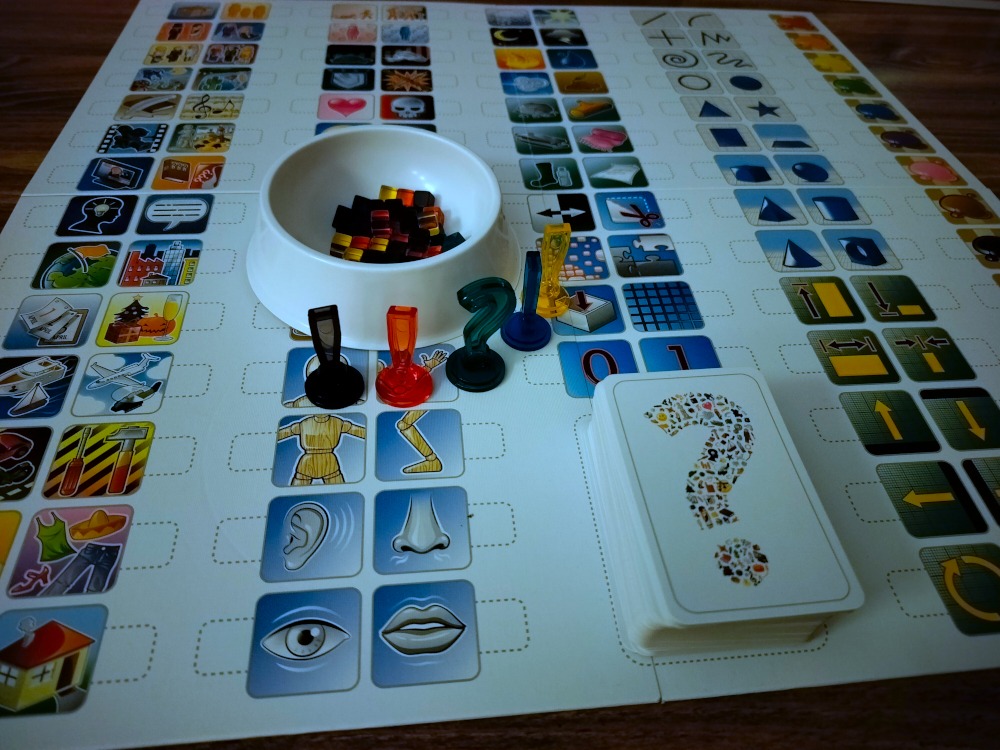
The box includes a deck of cards, four reference sheets (not shown), a board with a grid of little images, a sheet of lightbulb chits (not shown), five color-coded tokens, and a bowl of color-coded cubes. The images on the board form a vocabulary that is defined on the reference sheets. As I said, you use this vocabulary to try to communicate a target concept. You do that with the tokens and cubes, the grammar.
The tokens indicate concepts and the cubes indicate modifiers. The green token is special, though; it indicates the main concept. This is the concept that most fundamentally describes your target. For instance, suppose our target is “soldering iron.” We could put the green token on the “tool” square. This shows that the target concept is a tool. That’s a bit vague though: What kind of tool? What does it do? So we use a green cube to give a modifier to our tool. We put a green cube on “electronic”. Then we have an “electronic tool” or a “tool used in electronics.” We are on our way, but it’s still a bit vague. We can do better.
The other tokens are for sub-concepts. They also have matching cubes. These are used to clarify the main concept with a related concept. Continuing on, we can put a sub-concept token on the square for “do - verb”. This is to indicate that we intend to describe what the tool does or something you do to the tool. Then you place matching cubes on “hot” and “metal”. With these hints together your teammates might put together “A tool for electronics that heats up metal.” Whether or not this leads to “soldering iron” is, as far as I can tell, entirely up in the air.
The whole time you are trying to convey your target concept, you are not allowed to speak except for saying “Yes.” You can’t even clarify that you meant “do - verb” and not “button.” As you quickly learn, the way you think about the target concept, or even the vocabulary, is not universal. And even when they are held in common, sometimes you just can’t connect the dots. This has been proven to me both frustrating and hilarious. I’ve had a lot of laughs just recalling specific exchanges like this one:
A: "It's some kind of hot yellow dirt!"
B: "Yellowcake uranium?"
(It was sand.)
In typical play, you have competing teams. This requires four or more players. Target concepts are drawn from a deck of cards. Team members take turns giving hints. Other players guess. Success accrues lightbulb chits. More lightbulbs means you win.
But it doesn’t need to be played that way. The game is perfectly playable cooperatively. This works with 2 or more players. All players take turns giving hints and guessing. You can distribute the lightbulbs however you want. (I give them out to players who guess correctly. I may later release a chart of point targets for cooperative play.)
The competitive angle is unnecessary. I think this speaks to the strength of the core game play. Because the fun of the game is in trying to communicate with equipment. Failure or success, you learn something about yourself and your friends. Something about how we encode the world.
First Post
hello, world. so, i have a cat; a beautiful calico. she’s the color of blended, melty s’mores, and she’s stuck to my heart. she also has a snaggle tooth because of all the teeth she’s had pulled. it gives her a shocked appearance after she yawns.
she’s very noisy too; always meowing after something. usually food but sometimes play. “no kitty, you already had breakfast…” she used to struggle with really bad alopecia. that got a bit better when we switched her to wet food. she also has a problem that when she gets very agitated, she will pee on stuff. for that, we have hormone diffusers that chill her out.
i love her a lot. she wakes me up at 9 o’clock every morning. and she does not let me sleep in. i used to resent that a little but now i’m less tired. maybe she saw i had a problem and tried to intervene like i do for her. returning the favor in the form of good sleep hygiene… (nah, she just wants her food.)
i’m a bit like her; a bit of a nervous person. it really is a lot of little adjustments like that that make life more bearable. if you can do it for your cat you can do it for yourself, right? why suffer if you don’t have to? let your humans feed you wet food today.


Last updated on 19-Oct-2026.